
The Odd Bird author on books, birds and bikes.
Odd Bird took a while to fledge, it’s fair to say.
In March 2003 I moved to North Carolina with my girlfriend. By June, she had returned to the UK and I was licking my wounds. Heartbroken and a long way from friends and family, I moped.
I’m a gifted mope, but I soon started to tire of it. Seeking a breakthrough, I bought the kind of bike which makes your arse plead for mercy and I enrolled in a creative writing workshop.
I arrived at the workshop expecting flip charts and biscuits but almost immediately we were writing from prompts and the teacher was encouraging us all to read to the group. Read! Did she say read?
I was terrified, but eventually read a very short piece about three boys and a treehouse. At the end of the workshop, the teacher came over to speak to me. ‘You have to keep writing,’ she said. ‘You have a voice.’
I was so happy that on the ride home I almost forgot about my arse.
I started to think about what I was going to write. ‘Write what you know,’ the teacher had said. I knew about molecular biology and genetics and I definitely knew that relationships were tricky. One Saturday afternoon in a sprawling Barnes and Noble bookshop, I came across a popular science book called Mating Games. In it I read about a mischievous little bird called the pied flycatcher. ‘Hmm,’ I thought, ‘they’re as a bad as we are.’
Fast forward a decade comprising a load of busy and a bit of writing – and I got dumped again. This time the wounds were inflicted by an employer, but they needed licking all the same.
On the evening of the announcement I met with my friend Antony for a curry because he is the world’s foremost optimist and because curries are good for endorphins.
‘What will you do?’ he said, snapping off half a poppadum.
I told him I was going to take some time out. ‘I might write a book about strategic marketing,’ I said, trying to sound brighter.
‘Ha! Don’t be ridiculous, man,’ he said, reaching for the lime pickle. ‘You should write that novel you’re always rattling on about. About a bird, isn’t it?’
Next day I started telling everyone in my path that I was going to write a novel. It was going to be about a scientist who studies the sexual behaviour of birds but struggles to find love.
This might all sound very foolish, and I am often foolish, but I wasn’t, I think, foolish on that occasion. You see, I knew that writing would be hard. I knew that I would be tempted to give up. I knew that fear of public failure would drive me on.
Writing Odd Bird was a great experience. It’s definitely the best inanimate thing that ever happened to me. I loved getting to know Simon and the rest of the characters. People tell me, my daughter especially, that it’s not appropriate to laugh at your own jokes ─ but I did. Sorry.
So what about my prediction? Yes, writing was hard, especially at the start. The ‘voice’ that kind teacher from North Carolina had spoken of proved to be elusive.
In fact, I used to positively dread turning on the computer. In order to force myself to write I would set a timer. For twenty-five minutes I wasn’t allowed to do anything but write. When the alarm chirped I was allowed a fifteen minute break, during which I would try to learn to juggle. Why juggling? Because I reasoned that if I could teach myself to juggle then I could teach myself to write. Of course this seems crazy now ─ except it kind of worked. Gradually, the dread dissipated, the pleasure grew, the breaks got shorter and finally, the juggling balls were forgotten.
After that initial period, Odd Bird was a huge amount of fun to write. I hope people will feel that as they read it.

Odd Bird by Lee Farnsworth is publishing 1 October 2020.
Pre-order it from Amazon, Apple Books, Google Play Books, Kobo,
Waterstones or Hive.
 I write about animals quite a lot. In my books, I mean, not random notes scribbled in crayon about the fact that next door’s cat has pooed in my window box again. Book Animals can do a lot for a plot; show a character’s caring nature, necessitate an emergency drive to the vet, unite a neighbourhood to search for a missing pet, even wear a cute apron and cap if you are prone to Mrs Tiggywinkle. They can bring characters together, give them reasons to argue and just generally be cute and adorable and picturesque if you are short of something to put on your book cover.
 But, because I have Realism running through me like Scarborough through a stick of rock, my book animals must also behave like real animals. I couldn’t write Mrs Tiggywinkle-type fiction if I tried, because I’d spend too much of the book wondering whether slug stains wash out of aprons and who goes around picking up the caps after the inevitable car collision. So my book dogs go through rubbish bins, embarrass their owners in public and dig enormous holes in the garden when left unattended; my book cats bring in headless rabbits which they leave in the middle of clean duvets – just like the real thing.
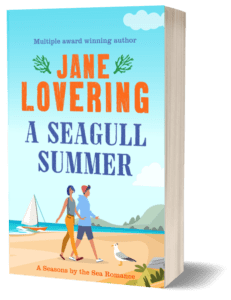
So my recent book has a hand-reared seagull in it. Which gave me a slight advantage, because nobody expects a seagull to be cute and fluffy. Everyone has had their chips stolen or been sullenly regarded from a nearby roof by a bird that looks as though it’s wondering what you’d taste like. A seagull can get away with being a little bit unlikeable, because they are basically big, noisy sandwich-thieves with worryingly mad eyeballs who can fly. Like insane burglars in a hang-glider. With a vuvuzela. Basically, seagulls are not a traditional ‘pet’, but that’s fine because my couple aren’t a traditional couple either! Neither character would have suited a typical book pet, in any case.
In real life, I have a cat who shouts outside my front door at irrational hours, and a uniquely horrible terrier. Neither one of them would make a good Book Pet. Cat only turns up occasionally and thinks he belongs to most of the village, so is no good for plot development. Unless I were to go around the neighbours to search for him with hilarious consequences, but I know he’ll come back on his own, so I don’t. Dog won’t let any potential love interests come within a lead’s length of me without trying to take their leg off, and will kill and eat anyone who spontaneously calls at the house, so she’s hardly going to add to my character arc. Unless my arc is to become housebound and terrified of people, which would be a bit of a rubbish story really.
I’ve got a good mind to make both of them wear aprons and caps. That would teach them.
But, because I have Realism running through me like Scarborough through a stick of rock, my book animals must also behave like real animals. I couldn’t write Mrs Tiggywinkle-type fiction if I tried, because I’d spend too much of the book wondering whether slug stains wash out of aprons and who goes around picking up the caps after the inevitable car collision. So my book dogs go through rubbish bins, embarrass their owners in public and dig enormous holes in the garden when left unattended; my book cats bring in headless rabbits which they leave in the middle of clean duvets – just like the real thing.
So my recent book has a hand-reared seagull in it. Which gave me a slight advantage, because nobody expects a seagull to be cute and fluffy. Everyone has had their chips stolen or been sullenly regarded from a nearby roof by a bird that looks as though it’s wondering what you’d taste like. A seagull can get away with being a little bit unlikeable, because they are basically big, noisy sandwich-thieves with worryingly mad eyeballs who can fly. Like insane burglars in a hang-glider. With a vuvuzela. Basically, seagulls are not a traditional ‘pet’, but that’s fine because my couple aren’t a traditional couple either! Neither character would have suited a typical book pet, in any case.
In real life, I have a cat who shouts outside my front door at irrational hours, and a uniquely horrible terrier. Neither one of them would make a good Book Pet. Cat only turns up occasionally and thinks he belongs to most of the village, so is no good for plot development. Unless I were to go around the neighbours to search for him with hilarious consequences, but I know he’ll come back on his own, so I don’t. Dog won’t let any potential love interests come within a lead’s length of me without trying to take their leg off, and will kill and eat anyone who spontaneously calls at the house, so she’s hardly going to add to my character arc. Unless my arc is to become housebound and terrified of people, which would be a bit of a rubbish story really.
I’ve got a good mind to make both of them wear aprons and caps. That would teach them.
A Seagull Summer by Jane Lovering (featuring Roger, the seagull!)
is publishing 6 August 2020.
You can pre-order it here.
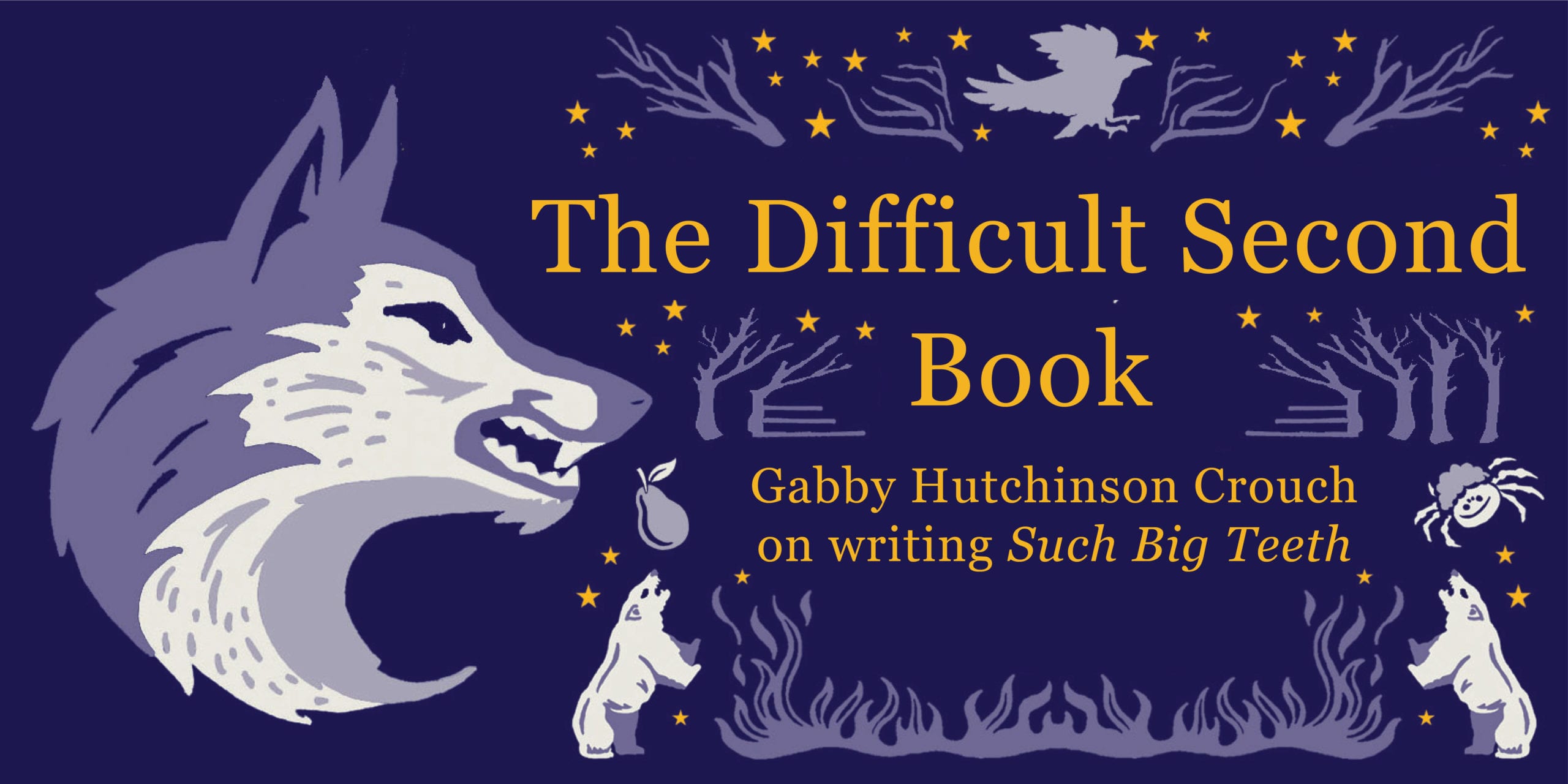
…That Isn’t So Difficult When Your First Book Was Actually An Unloved Pilot
Gabby Hutchinson Crouch, author of the beloved Darkwood series, on writing
her second book Such Big Teeth.

Darkwood wasn’t supposed to be a book. Darkwood was supposed to be a CBBC series. Part Avatar: The Last Airbender, part Steven Universe, part Maid Marian & Her Merry Men.
I wrote a pilot script in a hurry, out of several different ideas that had been in my mind for years, for a BBC Writersroom competition, where it was swiftly rejected.
By then, I loved the characters and the concept too much to just let it die, so, in quiet periods of work, I tried rewriting the pilot script as prose.
Writing a book from a script had a few surprising side effects. One was that the narrative voice naturally took on a conversational tone in the present tense, as if I was writing directions for a production team I was friendly with.
Another side effect was that, because I’d been thinking about a longer-term series, I already had a rough idea sketched out of how I thought a series of books might pan out.
I wrote the first half of the first book, started looking around for potential publishers, and happened upon a tweet about Farrago looking for genre comedy series, at just the right time. I had the synopsis for the second half of the first book planned out, and like a good little broadcast media writer, I had some loose ideas for a bigger story arc.
I’m not going to lie to you, mostly those loose ideas for an arc structure came from movies and video games.
One of my concepts for expanding the world in three books was as such: Isn’t it great when you’re playing a narrative open world game where after you complete one big boss level about a third of the way in a new chunk of the map opens up for you to explore?
Darkwood has a literal map of the forest in the narrative, with large parts of it still blank by the end of the first book, for Gretel to fill in. This is absolutely influenced by my love of games like Red Dead Redemption 2 and Zelda: Breath of the Wild.
I also wanted to introduce some new fairy tale characters for the expedition into the uncharted northern woods in book 2.
I had a lot of fun coming up with the northern witches. I’d already had an idea that the north would be the territory of witches who could control larger, scarier animals such as wolves and bears, so Red Riding Hood and Goldilocks were obvious choices.
The third ‘witch’ was initially going to be The Fox Prince, but I decided I really wanted to go with a character from an obscure fairy tale that I love – the cursed youngest brother from the six (or sometimes seven) ravens story. I also wanted to open up a bit more of the antagonists’ territory, so we see a lot more of the huntsmen and their Citadel.
Also, because Darkwood is a trilogy, I got to use The Star Wars Trajectory, so the second story is a little bit darker, with the heroes suffering more losses. In the second story of a trilogy, you have to up the stakes while still leaving plenty of room for the third story to go. The upside of this is that you can leave a few story threads unresolved for the third and final story.
That’s Future Gabby’s problem to solve.
Such Big Teeth, the second book in The Darkwood Series, is publishing on 25 June 2020 – find out all about it here!


Drop us a line
Follow us on Twitter
Like us on Facebook